

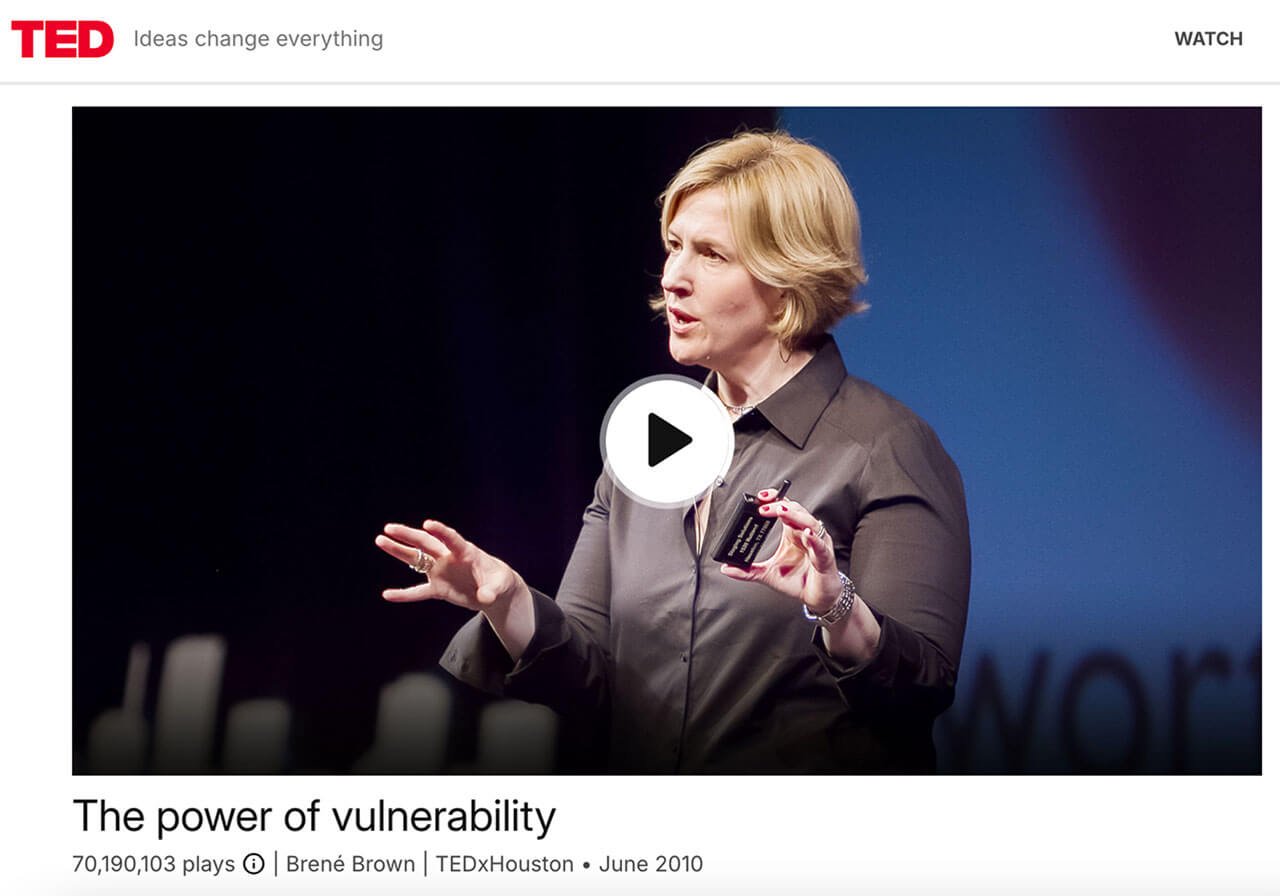
The Brene Brown TED talk The Power of Vulnerability now has over 70 million views. It not only went viral. It rebuilt her entire career.
She was a research professor nobody outside of Houston had heard of.
In June 2010, at a local TEDxHouston event in front of 500 people, she gave what would become one of the most-watched TED Talks. It inspired many people encouraging them to be vulnerable to build the connection they craved.
Here’s a full case study on Brene Brown TED Talk The Power of Vulnerability and how she became a recognized speaker.
Brene Brown TED Talk Speaker Background
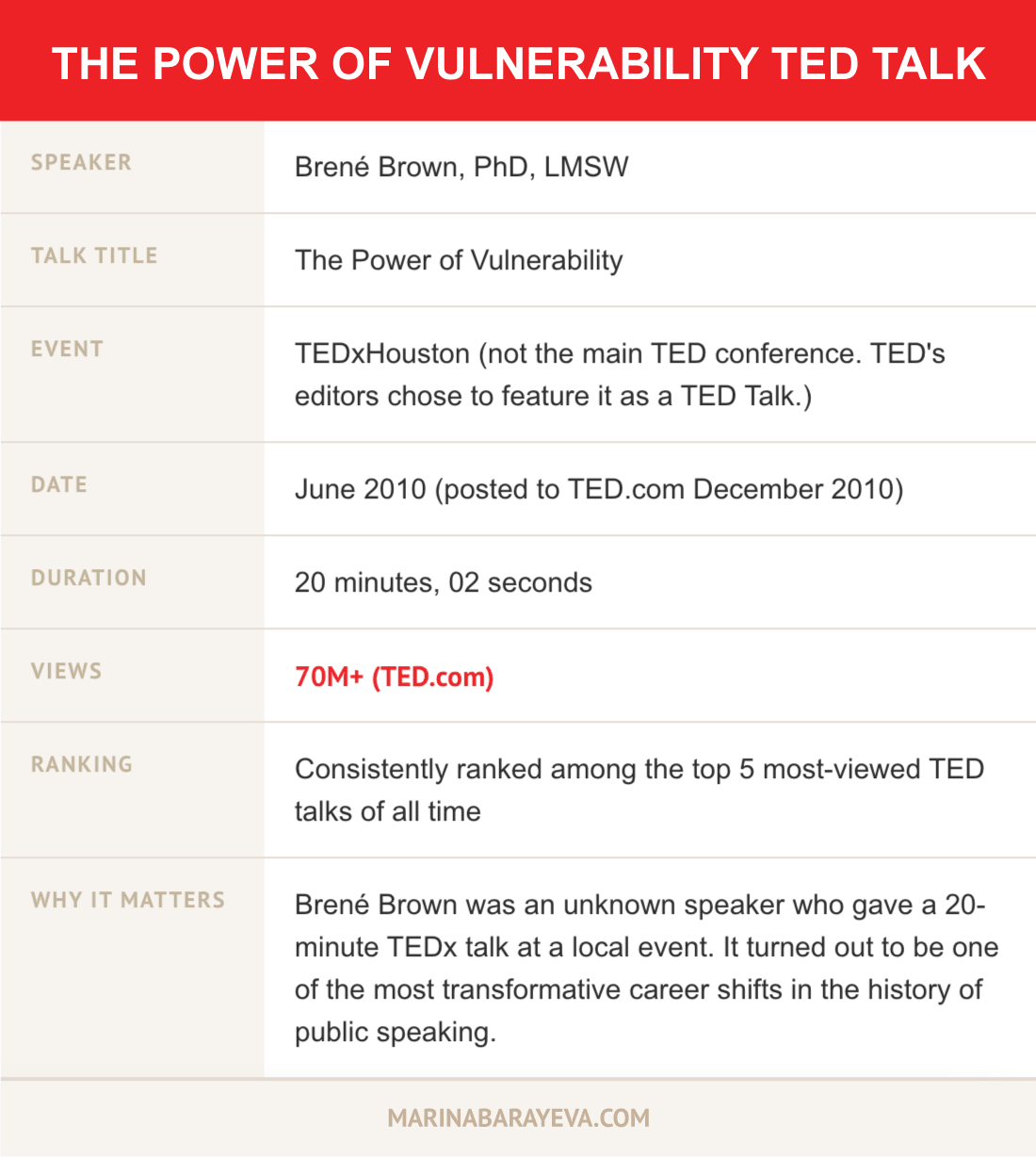
Brené Brown was an unknown speaker who gave a 20-minute TEDx talk at a local event. It turned out to be one of the most transformative career shifts in the history of public speaking. First, she became a TEDx speaker, and later her talk was recognized and featured as a TED Talk.
How Brene Brown became famous
Brene Brown wasn’t a famous celebrity when she gave her TED Talk. She was a local professor invited to speak at a local TEDx event. It was the talk that made the speaker, not the other way around.
The virality of her talk was completely organic. This shows that anyone, regardless of their fame, can have a powerful impact if they give a speech that matters to the audience.
Brene Brown’s Career BEFORE The Power of Vulnerability TED Talk
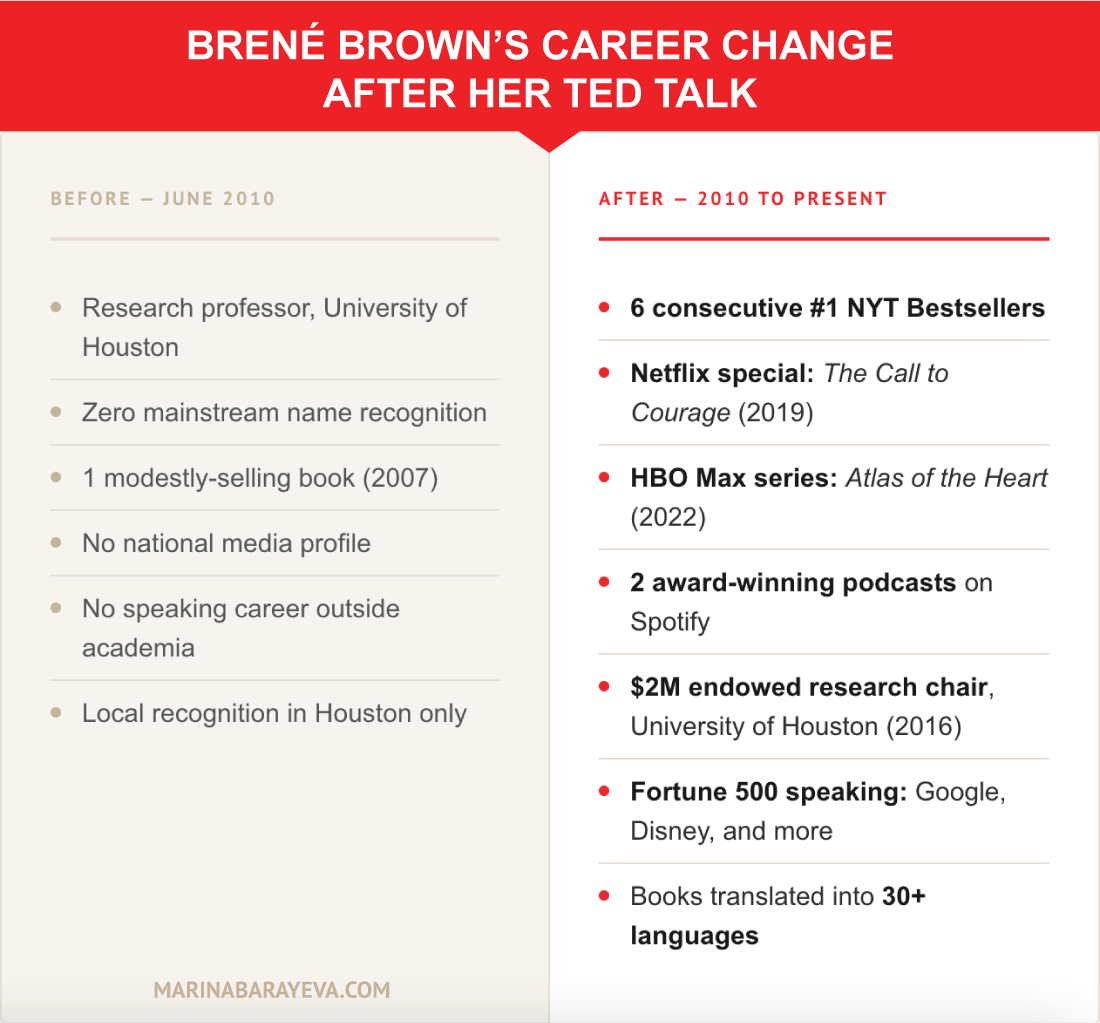
Before giving a TED Talk The Power of Vulnerability Brene Brown was an academic unknown outside her field. She had some recognition in the research and social work communities in Houston, but she didn’t have a well-known personal brand. Houston Woman Magazine named her one of the city’s most influential women in 2009, but she wasn’t famous.
Her credibility:
- Bachelor’s and Master’s in Social Work from UT Austin (1995, 1996).
- PhD in Social Work from University of Houston (2002).
- Over a decade of peer-reviewed qualitative research on shame, vulnerability, and human connection using grounded theory methodology.
- Had published one book before the talk: I Thought It Was Just Me (2007), which received modest sales.
- Brene Brown also has a less well-known TEDx Talk from 2010 given at TEDxKC titled The Price of Invulnerability (officially posted on YouTube in October 2010).
The Power of Vulnerability TED Talk made her a famous speaker.
Brene Brown’s Career AFTER The Power of Vulnerability TED Talk
By early 2012, her TEDx talk had been posted to TED.com for a little over a year and already had more than 3 million views.
Brene Brown was invited to the main TED2012 stage to give a follow-up talk, Listening to Shame. That was just the beginning.
The career that followed is unlike anything else in TED history:
Brene Brown’s Books:
Six consecutive #1 New York Times bestsellers
- The Gifts of Imperfection (2010)
- Daring Greatly (2012)
- Rising Strong (2015)
- Braving the Wilderness (2017)
- Dare to Lead (2018)
- Atlas of the Heart (2021)
The Gifts of Imperfection alone has sold over 2 million copies in 30+ languages.
Brene Brown on Netflix
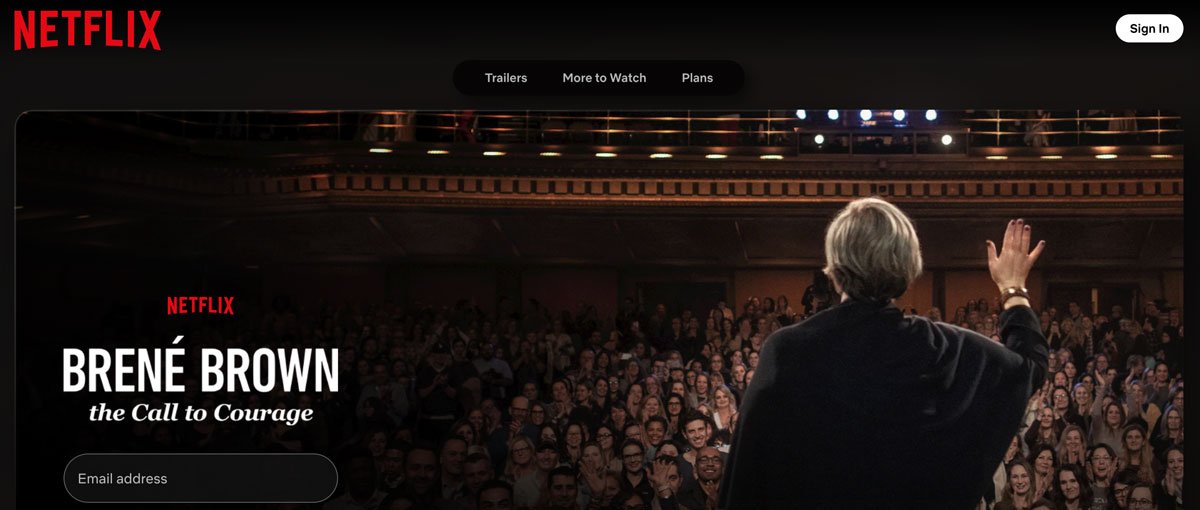
The Call to Courage (2019) – the first filmed lecture by a researcher to air on Netflix. USA Today described it as part motivational speech, part stand-up comedy.
Brene Brown on Television
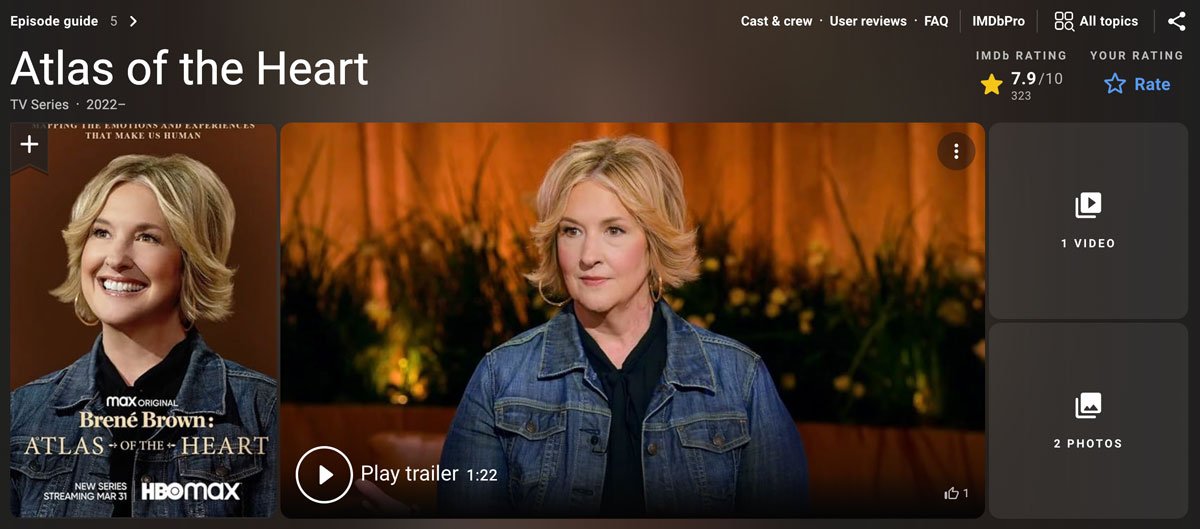
A five-part HBO Max series, Atlas of the Heart, in 2022.
Brene Brown Podcasts
Brene Brown hosts Unlocking Us and Dare to Lead podcasts on Spotify. Unlocking Us won the iHeartRadio Podcast Award for Best Advice/Inspirational Podcast in 2021.
Brene Brown’s academic recognition
In 2016, the Huffington Foundation endowed a $2 million research chair at the University of Houston in her name. She also became a visiting professor at UT Austin’s McCombs School of Business.
Brene Brown’s corporate speaking
Regular engagements at Fortune 500 companies, including Google and Disney.
She became CEO of The Daring Way, a professional training and certification program.
In 2024, she was named Executive Chair of the Center for Daring Leadership at BetterUp.
Brene Brown’s awards
National Association of Social Workers International Rhoda G. Sarnat Award (2016).
Goodreads Choice Award for Best Nonfiction for Atlas of the Heart (2022).

Co-Authorship
Co-created You Are Your Best Thing (2021) with Tarana Burke, an anthology addressing vulnerability and shame in the Black experience.
Brene Brown TED Talk summary
In her TED Talk The Power of Vulnerability, Brene Brown shares a discovery that changed how she lives, loves, and works. After being a social worker for 10 years, she found that connection is what gives purpose and meaning, but shame and the fear of not being enough break that connection.
After interviewing thousands of people, she noticed that those who felt genuinely loved and connected all shared one belief: they believed they were worthy of it.
She shares that vulnerability means to be open, imperfect, and willing to show up.
Brene Brown shares in her TED Talk that it was hard for her to accept this. She liked control, and vulnerability felt like weakness. But her research showed the opposite: vulnerability is the starting point for joy, creativity, and love.
Her takeaway is stop numbing the hard feelings, let yourself be truly seen, and believe that you are enough. If you want to be seen and feel connected, be vulnerable.

WOULD YOU LIKE TO LAND A TEDx TALK WITHIN THE NEXT FEW MONTHS?
Get this TEDx guide that will help you prepare and increase your chances of getting accepted.
Why Brene Brown’s TED Talk Went Viral
Brené Brown’s TED Talk went viral because everything worked together. The idea of vulnerability challenged a deep belief people already had. She took the audience on a journey to discover what matters to them and made people feel her experience and discover the insight with her. The message was simple and easy to apply to real life.
Her delivery made the message even stronger. She was honest and vulnerable, which made people trust her and see themselves in her story. Instead of trying to impress, she focused on connection.
Most importantly, the talk proved that you don’t need to be famous to make an impact.
If your idea matters, and you share it in a real and relatable way, people will listen and they will share it.
Saying the talk went viral because she was “authentic” is like saying a building stands because of “good architecture.” It is true, technically, but completely useless as analysis.
So, let’s break down Brene Brown The Power of Vulnerability TED talk to uncover what really made it work and go viral.
Brene Brown’s TED Talk Big Idea
Brene Brown’s big idea is this:
In order for connection to happen, we have to allow ourselves to be seen, really seen. If you want to feel connected be vulnerable.
Her main idea is simple: vulnerability is not a weakness. It’s the starting point for courage, joy, and connection. This goes against what many people believe, especially in professional spaces, where showing emotions is often seen as a risk.
That’s the first rule of a viral idea:
Challenge a belief your audience has. Brene Brown didn’t just look at what people believe in. She turned this belief upside down.
Public Speaking Techniques Used in Brene Brown’s TED Talk
In Brené Brown’s TED Talk The Power of Vulnerability, she does a remarkable job of uncovering her central idea by leading the audience through different stories to the point where she emphasizes the importance of vulnerability and how important it is to be vulnerable, to feel connected, to be seen.
Here are the public speaking techniques that Brene Brown used in her vulnerability TED talk that helped her talk go viral and that you can apply to your public speaking:
1. Start a Speech with an Opening Story
Brene Brown opens her TED Talk The Power of Vulnerability with a story about an event planner who didn’t want to call her a “researcher” because she thought people would find it boring. They decided on “researcher-storyteller.”
This 90-second opening makes the audience laugh, positions Brene Brown as self-aware and relatable, and frames the entire talk as the story of a researcher who had to learn to be human.
Note: this is an opening hook, not her origin story. An opening hook creates immediate connection and sets the tone.
An origin story answers a deeper question: what happened that made you who you are, and why does this work matter to you personally?
That moment comes later in the talk. See #3.

Why It Works
Audiences connect faster with speakers who show some weaknesses or tension before they establish authority.
Psychologists call this the “pratfall effect.” It means that when someone who is already seen as skilled or competent makes a small mistake, people tend to like them more.
The mistake makes them feel more human and relatable, instead of perfect and distant.
Brene Brown doesn’t lead with her PhD. She leads with her discomfort about her PhD.
How to Apply It
Before your next presentation, identify one honest tension you feel about your topic or credentials. Write a 60–90 second story that shows that tension and open with it before your first “real” point.
A financial advisor might say:
“The irony of being a financial planner is that the worst financial decision I ever made was the one I made with the most data.”
2. Turn Research and Data into Stories
Although Brene Brown is a researcher, she primarily tells about her studies through stories. She is a very good storyteller, so she does not tell you in a way that is like a statistic or analytical, but she tells it in a way that is just a story of her discovery.
She doesn’t say “my research found that 73% of participants…” She says “I found two groups of people. Here’s what separated them.”
The data creates mystery and structure, but the emotion carries the message. This is radically different from how most researchers and business speakers present their work.
Also, she brings each story back to the main point: why vulnerability matters for connection. That way she keeps the audience’s focus on her big idea.

Why It Works
Talking only about data and stats gives your audience the final results. But when you present your data as a story, you invite them to discover it with you.
When the audience gets an insight on their own, instead of being told what it is and what to do, they remember it much better than if you simply show them the results.
How to Apply It
Take your most important insight. Instead of presenting it as a fact, reframe it as a journey:
“I spent [time] studying [topic]. I expected to find [A]. Instead, I found [B], and it changed how I see everything.”
The discovery feeling makes data feel like a story.
3. Tell the Origin Story
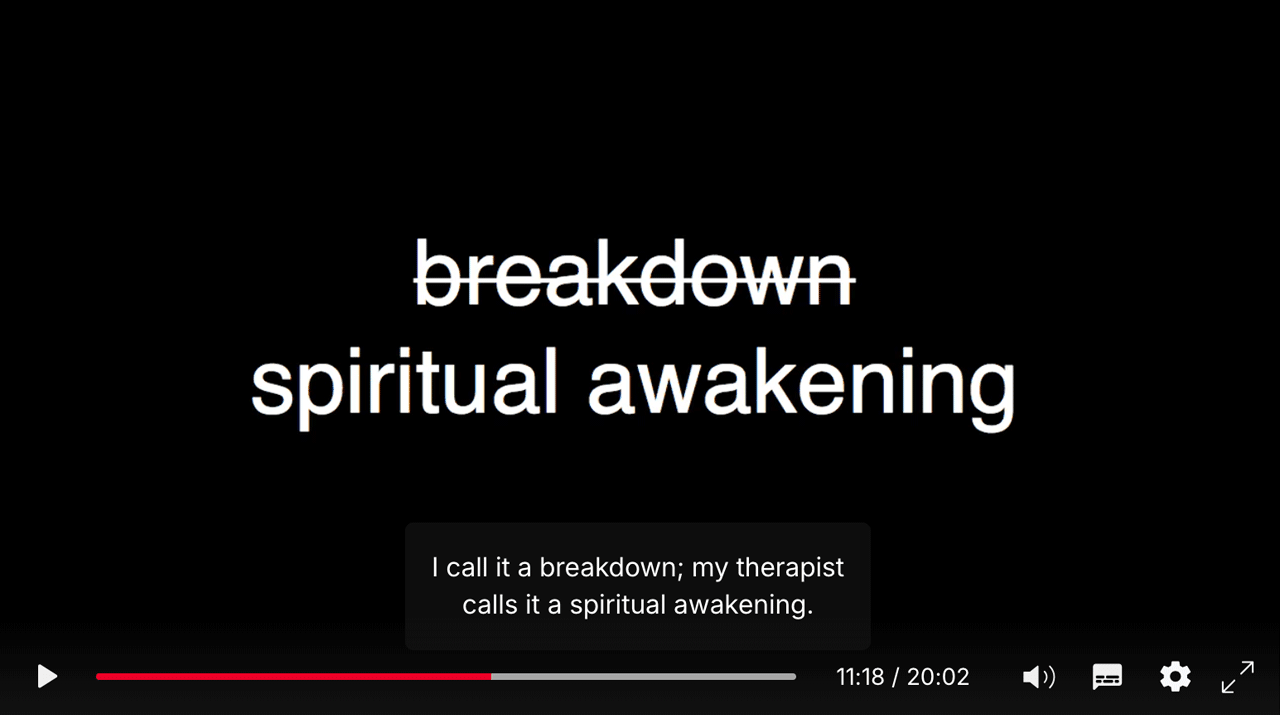
Around minute nine of Brene Brown TED Talk The Power of Vulnerability you’ll see that her discovery about vulnerability felt like it was betrayal.
This is her origin story that shows how she got her insight about vulnerability and what it means for her and others.
She shows an actual slide with the word “Breakdown” on it. Then she crosses it out and writes “Spiritual Awakening.” The audience goes from laughing to silent.
Why It Works
Everything before this breakdown is “the researcher tells you what she found.”
Everything after is “the human being tells you what it cost her to accept it.”
The shift from third-person authority to first-person vulnerability is the structural pivot of the entire talk.
Without it, this is a competent academic presentation. With it, it becomes a shared human experience.
How to Apply It
Look for the moment in your own life where you had a breakthrough about your idea that you want to present on stage.
That moment of personal transformation is often the most important thing you can share.
Many speakers leave it out or tell way too long story about their whole life. Instead, make it short – just about the transformation that you experience and that led you to the insight you share with people.
4. Use Humor to Keep the Audience Engaged
Brene Brown makes people laugh a lot during her speech. For example, telling a story about how she searched for a therapist (“don’t bring your measuring stick”) or the “breakdown / spiritual awakening” reframe using slides.
Each time the audience laughs, she stops and lets the laughter fully land before continuing. That deliberate pause does two things: it tells the audience she’s present with them, not just delivering material at them, and it gives people a moment to breathe before she moves forward.
This is an important distinction: the laughs aren’t just entertainment, they’re evidence that the audience is emotionally engaged and tracking with her, not passively sitting through a lecture.
She earns their attention through humor, and then she uses that earned attention to take them somewhere vulnerable.

Why It Works
Humor helps establish the emotional contract with the audience. The laughter shows that they enjoyed the talk and they were present during her speech.
It also creates a contrast between the jokes in the first half of the speech and emotional weight of her big idea of vulnerability in the second half.
How to Apply It
If your topic is heavy or personal, don’t open with the heavy part. Find the absurdity in your own story first. Make them laugh before you make them feel. The contrast will amplify both.
5. Close with a Single Idea
Brene Brown ends her TED Talk The Power of Vulnerability with something deceptively simple: the invitation to believe you are enough. After twenty minutes of emotional intensity, that single “believe you are enough” still sentence lands like a chord resolving.
“Believe you are enough”
Why It Works
A simple closing phrase holds the space the talk created. The contrast between 20 minutes of energy and a single still sentence produces what musicians call a “dynamic drop,” and it’s the moment audiences remember better.
How to Apply It
If your talk has been emotionally intense, don’t try to top yourself at the end. Lower your voice. Slow down. End with a single sentence that captures the essence of everything you’ve said. The contrast between the energy of the talk and the stillness of the close creates a lasting emotional imprint.
The Audience of The Power of Vulnerability TED Talk
Brene Brown’s TED Talk on vulnerability resonates with a very broad audience, but especially with women aged 25–55 who are interested in personal growth, relationships, and emotional well-being.
It also strongly resonates with leaders, therapists, educators, parents, and anyone struggling with shame or perfectionism.
Overall Delivery of The Power of Vulnerability TED Talk
Brene Brown changes the way she speaks throughout the talk. She speeds up during stories to build energy, then slows down and lowers her voice for key moments. She also uses pauses to let ideas sink in and give the audience time to feel and reflect.
This variety helps the audience know what matters. When she speeds up, it feels like a story. When she slows down and pauses, it signals an important point.
Why Brene Brown’s TED Talk Went Viral (Interesting Fact)
Brene Brown gave her speech at TEDxHouston, an independently organized local event in Houston, not the main TED conference in Vancouver or Long Beach.
After the event, TED’s editors chose to feature it on TED.com. That’s how it became The Power of Vulnerability TED Talk and reached a much bigger audience.
Also, TEDx had only started in 2009, so in the early years these talks were getting a lot of attention. This gave speakers with strong ideas more traction and visibility.
So, the combination of a strong big idea, engaging delivery, and TED support helped Brene Brown’s TED Talk go viral.
WOULD YOU LIKE TO LAND A TEDx TALK WITHIN THE NEXT FEW MONTHS?
Get this TEDx guide that will help you prepare and increase your chances of getting accepted.
FAQs
Who is Brene Brown and why is her work important?
Brene Brown is a research professor, author, and speaker known for her work on vulnerability, shame, courage, and human connection. What makes her work important is that she helped change how people see vulnerability, from something to avoid to something needed for real connection.
Her unique public speaking style is that she takes complex research and explains it in a simple, practical way that people can use in real life – at work, in relationships, and in everyday situations.
What is Brene Brown known for?
She is best known for her Brene Brown TED talk The Power of Vulnerability, her six New York Times bestselling books, her Netflix special The Call to Courage, and her frameworks around wholehearted living, shame resilience, and daring leadership. She brought the concept of vulnerability into mainstream leadership and personal development conversations.
How much does Brene Brown charge to speak?
Brene Brown is widely reported as one of the highest-paid speakers in the world, with fees in the range of $200,000–$400,000 per engagement for corporate events. However, exact figures are not publicly confirmed and vary by event type and scope. For the most current speaking fee information, the best source is her official representation.
(Source: Washington Speakers Bureau and other speaker booking agencies list her in this range, though Brown’s official site does not publish fees directly.)
How did Brene Brown become famous?
In the TED talk, Brene Brown became famous after giving a TED talk The Power of Vulnerability at the TEDxHouston event in June 2010, which TED’s editors featured on TED.com in December 2010. The talk went viral organically over the following months. By early 2012, it had over 3 million views and she was invited to give a follow-up talk at the main TED2012 conference.
The combination of the talk’s viral spread and her following book Daring Greatly (2012) established her as a global thought leader.
How does Brene Brown define vulnerability?
In the talk, Brene Brown defines vulnerability as uncertainty, risk, and emotional exposure. In simple words, it’s the feeling you get when you don’t know what will happen, you might get hurt, and you still choose to show up and be seen.
Critically, she argues that vulnerability is not weakness. It is the beginning of connection, creativity, love, and belonging. Avoiding it is what leads to numbness and disconnection.
Where does Brene Brown teach?
Brene Brown has held a position at the University of Houston Graduate College of Social Work, where the Huffington Foundation endowed a $2 million research chair in her name in 2016. She has also been a visiting professor in management at UT Austin’s McCombs School of Business.
What is Brene Brown’s latest book?
Her most recent book is Strong Ground, published on September 23, 2025. (For any newer publications, check her official site at brenebrown.com)
The Brené Brown TED talk remains one of the most instructive case studies in what makes an idea spread.

