If you haven’t yet, start collecting public speaking tips to become a professional speaker.
Public speaking skills help you communicate with confidence. When you can explain your thoughts in a way that’s clear and engaging, people are more likely to listen to you and remember what you said.
It helps you influence and inspire people. It brings more awareness to your business, builds your personal brand, and accelerates your career. It even makes everyday interactions smoother.
Public speaking is also one of the fastest ways to stand out as an expert in your field and a leader.
Your experience backed up with the stories, examples, and a strong message can move people to take action. People will apply what you share, get results, and look for more.
You’ll be seen as an authority.
This guide gives you 10 public speaking tips to help you deliver engaging speeches that resonate with people.
The more you practice these tips, the more natural they’ll feel. Over time, you will start applying them without even thinking.
How to use these public speaking tips
Go through all the public speaking tips below and see what you can easily start applying in your everyday life during the small meetings.
It will help you practice the technique even before you prepare and perform a speech.
Start with the techniques that resonate most strongly with your current challenges.
- If your main problem is that you get too nervous, focus on breathing exercises and strong openings.
- If keeping the audience engaged is hard, work on interaction and the “So What?” exercise.
- If you want more authority, focus on cutting weak language and using strategic pauses.
This way, you will gradually improve your public speaking skills without feeling overwhelmed and will be more confident when you give a speech.
Let’s start with the public speaking tips that will help you get your audience’s attention.
1. Jump Straight into The Content
Often, you see speakers starting like this: “Good morning, thank you for having me, my name is…”
By the time you finish your greetings that way, half your audience has already checked out mentally.
They’re thinking about their next meeting, scrolling through their phones, or wondering how long this will take.
How to use this public speaking tip:
Instead of getting into all the polite formalities, start your speech by getting their attention with what’s interesting or important to the audience.

Your audience has their thoughts, concerns, and questions related to your topic. Start there.
Rather than saying:
“Thank you for coming to hear about our new project management system,”
try
“You know that feeling when you’re juggling five urgent projects and can’t remember which deadline is actually today? What if you could easily manage them all?”
You’ve just acknowledged their pain point and promised a solution within the first fifteen seconds.
This public speaking tip works because you immediately show that you understand your audience and your speech promises to be relevant to their needs.
Your audience thinks, “This person gets it. They understand what I’m dealing with.”
It creates instant engagement and establishes your credibility not through credentials or introductions, but by showing empathy and insight.

The key is specificity.
Generic problems get generic attention. Specific, relatable scenarios make people connect emotionally.
Instead of talking about “workplace communication challenges,” describe the exact moment when someone realizes they’ve been left off an important email chain and how that sinking feeling affects their entire day.
2. Talk to Your Best Friend in the Back Row
Here is a secret of the professional speakers: the bigger your audience, the more intimate your delivery should become.
This might seem backward, but it’s important to understand the psychology behind.
When speakers try to address “everyone,” they end up connecting with no one. When they speak to one person, everyone feels personally addressed.
Here’s the public speaking tip that will transform your presentation:
Scan your audience and find the most approachable face in the back row. Maybe it’s someone who’s smiling, nodding along, or simply looks engaged and friendly.

Now imagine you’re explaining your topic to this person over coffee. Speak directly to them with the same warmth and natural energy you’d use in a one-on-one conversation.
This approach solves multiple problems simultaneously.
First, it automatically improves your projection. When you speak to someone in the back, you automatically want to speak louder.
Second, it eliminates the overwhelming feeling of everyone staring at you. You’re just talking to one friendly person who happens to be surrounded by other people.
As you become more comfortable, you can gradually expand your focus.
How to use this public speaking tip:
- Step 1: Choose a new “friend” in a different section of the room and speak to them for a while.
- Step 2: Then switch to someone else.
This creates the impression that you’re making eye contact with everyone.
When this technique becomes second nature, your entire presentation transforms from a formal speech into an engaging conversation.
Now, let’s get to your speech. The next few public speaking tips will help you make some improvements in the way you speak.
3. Make It Relatable to the Audience
Remember your professor in college or university who bored you so much with his talk that you almost fell asleep? He was just delivering the information. Nothing engaging at all.
That’s because the fastest way to lose an audience is to share information without context. Facts without meaning are just noise.

Every piece of data, every story, every example you present should immediately answer the unspoken question your audience is always asking: “So what? Why should I care about this?”
This principle separates amateur speakers from professionals.
Amateurs just share information and hope people get it.
Professionals try to connect every point to what matters for the audience.
See the difference between these two approaches:
“Our customer satisfaction scores increased by 15% this quarter”
versus
“Our customer satisfaction scores increased by 15% this quarter. It means fewer angry calls for our customer service team and more positive reviews that bring in new business.”
The first statement is just a number. The second statement is a number with immediate, tangible meaning for the audience.
How to use this public speaking tip:
To effectively use this public speaking tip, ask “So What?” after every major point in your presentation.

That means:
- When you share a fact, explain why it matters.
- When you tell a story, tie it back to your main message.
- When you show data, say what it means for your audience’s everyday life.
For that, you need to truly understand your audience’s perspective, priorities, and concerns.
A 15% increase in customer satisfaction means something different to the CEO (revenue growth) than it does to the customer service representative (fewer difficult calls) than it does to the marketing team (better testimonials).
The main phrase can be even the same for all these people.
But tailor your “So what?” explanation so it connects with the specific group of people you’re speaking to.
4. Use Pauses to Emphasize Important Parts
A lot of times, speakers rush through their presentations trying to just get done with it. They are afraid that pauses will make them appear uncertain or unprepared.

This fear causes them to miss one of the most powerful tools in public speaking: the strategic pause.
Professional speakers understand that a well-placed pause before an important point builds anticipation.
A pause after a significant statement allows it to resonate. A pause during a transition gives the audience time to mentally shift gears.
How to use strategic pauses in public speaking:
- Step 1: Identify the most important statements in your presentation.
- Step 2: Mark them in your notes with “(pause 2-3 seconds)” before each one.
- Step 3: When you reach these moments, stop talking completely.
- Step 4: Count slowly in your head: “one thousand one, one thousand two, one thousand three.”
- Step 5: Then deliver your key point with conviction.
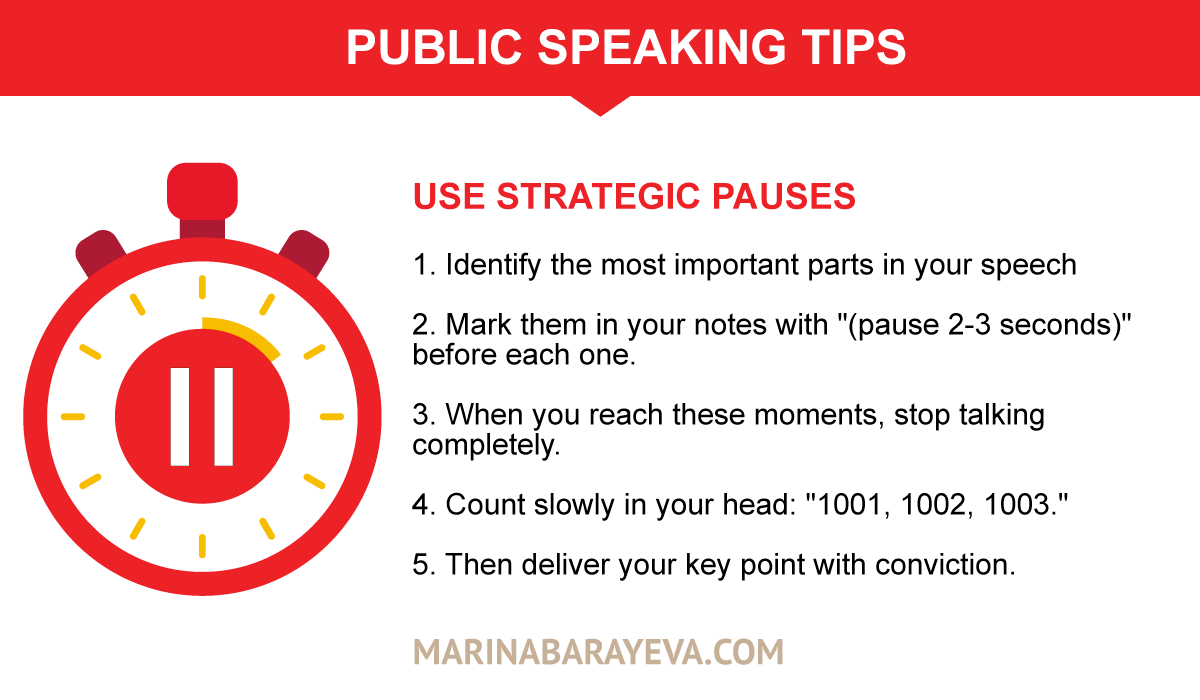
This “one thousand one” will help you keep the pause to about a second, rather than counting “1-2-3” – that’s too fast.
These pauses may feel like an eternity to you, but they will feel perfectly natural to your audience.
In fact, these pauses often signal confidence rather than uncertainty.
They demonstrate that you’re thoughtful, intentional, and comfortable with your speech.
Practice this public speaking tip until it becomes intuitive.
Record yourself delivering key parts of your speech with and without strategic pauses.
You’ll immediately hear the difference.
The version with pauses sounds more influential, more dramatic, and more engaging.
The audience has time to anticipate what’s coming and space to process what they’ve just heard.
The next public speaking tip will affect your whole performance.
5. Practice Your Opening and Closing Until They’re Automatic
People usually remember the beginning and the end.
The beginning sets the tone for the whole speech, and the ending leaves a lasting impression.
The first two minutes of any presentation are when your nervous system is most activated. It’s also the moment when your audience decides whether to pay attention or reach for their phones.
That’s why your opening is the most important and most vulnerable part of your entire presentation.
Then, the closing is what you leave people with and what they will remember. Just like the opening, make it strong and know what you want to say.

With that, even if you screw up somewhere in the middle, people won’t notice it that much.
How to use this public speaking tip:
Over-prepare your opening and closing until it becomes completely automatic.
Know your first 2 minutes and the last few sentences so well that you could deliver them flawlessly, even if you were distracted, nervous, or dealing with unexpected technical difficulties.
Practice your opening in various conditions.
Say it while walking around your house.

Deliver it while making your tea. Record it on your phone and listen back.
Practice it with distractions around. The goal is to make those first two minutes so familiar that your subconscious can handle them while your conscious mind adapts to the speaking environment.
This preparation creates a powerful psychological effect.
When you get your opening right, your confidence sticks for the rest of the presentation.

A strong start makes your audience respond positively, giving you momentum to keep going.
On the other hand, stumbling at the beginning can make you anxious and affect everything that comes next.
A solid closing feels like a winning finish. It leaves your audience impressed and ensures they remember your message.
If you have a speech that you deliver over and over again, consider creating multiple versions of your opening and closing:
- a shorter version if you’re running behind schedule,
- a longer version if you have extra time,
- and a backup version if your planned opening feels inappropriate for the specific audience or moment.
This flexibility, built on a foundation of thorough preparation, allows you to adapt confidently to any situation.
The next public speaking tip helps to make your speech more organized.
6. Use the Rule of Three
The human brain loves the number three.
We remember things better when they come in threes, we find three-part ideas more satisfying, and we naturally notice patterns of three.

Smart speakers organize their content using this “rule of three.”
What is the rule of three in public speaking?
In public speaking, the rule of three is the idea that people remember things best when they are presented in groups of three. It can be three main points, three stories, or three examples. Using threes makes your message simpler and more memorable for the audience.
For example, instead of listing five tips, a speaker might focus on three key tips. This helps the audience retain the information more easily.
It’s based on cognitive science. We can easily hold three to four pieces of information in our minds at once.
If a presentation gives more than that, people have a hard time keeping up.
Sticking to this rule of three makes it much easier for the audience to understand and remember what you talk about.
How to use the Rule of Three in public speaking:
- Look at your presentation and find your main points.
- If you have two points, think about a natural third that completes the picture.
- If you have four or more points, try combining similar ideas or cutting less important ones until you have three strong, clear themes.
The rule of three applies at multiple levels:
- Your whole presentation can have three main parts.
- Each part can have three key points.
- Each point can have three examples to explain it.
This layered structure gives your audience an easy-to-follow framework they’ll remember.
Even the way you speak can benefit from this principle.
Instead of saying “This solution is effective,” try “This solution is fast, reliable, and cost-effective.”
A three-part description is easier to remember and more convincing than a single word, and easier to understand than a long list of benefits.
The next public speaking tip will help create a visual connection.
7. Design Slides to Support One Idea per Slide
Speakers use slides to help the audience follow their presentation.
The biggest mistake is making slides that compete with what they’re saying.
If a slide has long paragraphs, bullet points, and several images, the audience has to choose: read the slide or listen to you.
They can’t do both at the same time.
Professional speakers know slides should support your words, not replace them.

How to use this public speaking tip:
For each slide show one clear idea with minimal text and strong visuals.
If you need to explain something complicated, say it out loud while showing a simple image or phrase that backs up your point.
Here’s the practical test:
- If someone could get your whole presentation just by reading your slides, they’re doing too much.
- If your slides add nothing to what you’re saying, they’re not doing enough.
- The best slides support understanding without taking attention away from what you’re saying.
Try replacing text-heavy slides with compelling images that show the feeling or idea you’re talking about.
Instead of a slide that lists all the “Benefits of Remote Work,” show a picture of someone working happily in a beautiful place while you explain the benefits out loud.

The image connects with emotions, and your words give the details.
This approach takes more preparation upfront, but makes your presentations much more engaging.
You, as an expert, become the main source of information, and the slides just support your words rather than serving as a teleprompter.
8. Warm Up Your Voice and Calm Your Nerves
Just like athletes who warm up before the Olympic Games or musicians who check their instruments before a performance, you, as a speaker, need to prepare your voice.
Five minutes of vocal preparation can transform your entire speaking experience.
How to use this public speaking tip:
Start with deep breaths using your diaphragm, not your chest.
Try “box breathing”:
- breathe in for four counts,
- hold for four,
- breathe out for four,
- hold for four.
Do this five times to calm your body and lower anxiety.
After the breathing exercise, do gentle vocal warm-ups:
- “Hum” softly for about twenty seconds to feel the sound in your chest and head.
- Try lip trills (like a horse sound) to loosen your face muscles.
- Say tongue twisters or read out loud clearly to get your mouth ready for speaking.
These exercises do two things:
- Physically, they get your voice ready, helping you speak louder, pronounce words clearly, and keep a steady pace.
- Mentally, they create a routine that tells your brain you’re about to do something important, turning nervous energy into focused energy.
Make this warm-up routine part of your pre-presentation habit.
Just like athletes have pre-game routines to perform their best, you, as a speaker, will benefit from regular preparation that gets your body and mind ready for a great presentation.
The next public speaking tip will help your audience feel like you’re having a conversation with them.
9. Create Interactive Moments
The best speakers know that talking alone is less interesting than having a conversation. Even if you’re the only one speaking, you can add interactive moments to turn your presentation from a lecture into a shared experience.
Simple ways to interact can make your presentation more engaging without needing special skills.
How to use this public speaking tip:
- Ask questions to make people think: “How many of you have felt this frustration?”
- Ask for a show of hands: “Raise your hand if you’ve tried to solve this problem.”
- Invite quick talks with a neighbor: “Turn to someone near you and share your biggest challenge with this issue.”
These interactive moments do a lot of good things:
- they break up long stretches of talking,
- get people moving (which keeps them alert),
- and give you quick feedback on how engaged your audience is.
They also give you natural pauses to breathe and gather your thoughts.
Plan your interaction depending on the kind of speech you give, the time you have, and the audience.
For example, if you give a TEDx talk, telling people to talk to each other about their biggest challenge isn’t a good idea because you don’t have much time for that.
But questions that make the audience think are perfect for a TED talk.
The key is to make participation feel natural. Your interactive moments should come from your content, not feel like random activities.
When you ask people to raise their hands, be ready to respond to what you see.

If fewer people raise their hands than you expect, notice it and adjust your approach.
Start with easy participation that doesn’t ask anyone to speak in front of others or share personal details.
As you get more comfortable and your audience gets more involved, you can add more interactive activities.
The goal is to make your audience feel like active participants, not just listeners.
The next public speaking tip will make you sound more authoritative.
10. Reduce Weak Language
The words you use show your confidence even before you share your main message. Weak language like “I think maybe we should possibly try this” can hurt your credibility and weaken your message.
Strong speakers use clear, confident words that show certainty and expertise.
How to use this public speaking tip:
The first step to fixing weak language is becoming aware of it.
Record yourself talking or practicing a presentation, and listen for weak phrases and filler words. Most people are surprised at how often they appear in their speech.
Common weak language includes phrases like “I think,” “maybe,” or “sort of,” unnecessary qualifiers like “I’m no expert, but,” and filler words like “um,” “uh,” or “you know.”
These habits are fine in casual conversation but can hurt your authority and clarity when presenting.
Replace weak language with stronger words. Instead of saying, “I think this might work,” say, “This approach will work because…”
Instead of, “I’m no expert, but,” try, “Based on my experience…”
And instead of filling pauses with “um,” just pause silently to gather your thoughts.
Changing your language takes practice.
Pick one weak language habit and work on removing it for a week. When you notice yourself using it, pause and say it more strongly.
Once you’ve improved on that habit, move on to the next one.
Doing it step by step stops you from getting so self-conscious that your speech feels awkward.
The goal isn’t to sound artificially formal or aggressive. It’s to match your words with your knowledge and confidence.
When you speak with certainty about what you know, your audience hears clear, confident communication.
The best ways to learn public speaking tips
The best ways to learn public speaking tips usually combine practice, observation, and feedback.
These ten techniques aren’t just public speaking tips. They’re your transformation tools. Each one addresses a specific aspect of the complex challenge of public speaking, from managing anxiety to engaging audiences to projecting authority.
Together, they create a complete approach that can help you turn public speaking into one of your greatest strengths.
To learn more public speaking tips and tricks:
1. Watch and learn from great speakers
Pay attention to TED Talks, keynote speeches, or even YouTube videos of skilled presenters.
Notice how they open, how they tell stories, how they use pauses, and how they connect with the audience.
You don’t need to copy them, but you can pick up techniques that feel natural to you.
2. Take a course or join a group
Formal classes, online courses, or groups like Toastmasters provide structured learning. They give you exercises, feedback, and opportunities to speak in a safe environment.
Being in a community also motivates you to practice regularly.
3. Practice deliberately
Speaking is like any other skill – the more you do it, the better you get. Start small with friends, family, or coworkers.
Record yourself and watch it back. Notice what works, what feels awkward, and what needs more practice.
4. Focus on small improvements
Don’t try to be perfect overnight. Pick one thing to improve at a time. You can choose pacing, gestures, or using stories.
Gradual progress builds confidence faster than trying to fix everything at once.
5. Step outside your comfort zone
Take opportunities to speak whenever possible, even in low-pressure settings.
Every time you speak in front of people, you develop your public speaking skills. You become more confident and learn something new about your style and how to engage with the audience.
What to do next with these public speaking tips:
There’s no single magic method to instantly become a good public speaker. What works is mixing different approaches so you build both skill and confidence.
Every professional speaker started small. The difference between them and speakers who are still afraid isn’t the talent. Professional speakers practice these proven techniques until they feel natural.
With consistent practice and learning from every experience, you’ll become a more confident and engaging speaker with every speech you give.