How to do a TED talk that supports your personal brand and boosts your public speaking career?
Giving a TED Talk is a chance to share your ideas with an international audience and build credibility, helping establish you as an expert in your niche.
This guide will show you how to do a TED Talk from scratch.
I’ll walk you through seven steps that will help you deliver a TED Talk that gets attention and strengthens your credibility.
But here’s the thing. Many people get it wrong from the very beginning.
They think a deep personal story or a solid framework is enough to give a TED talk. So they build their entire speech around that idea.
The problem is that a TED Talk is much more than a story or a framework. If that’s all you have, you’re missing a big part of what makes a good TED Talk.
What is the purpose of a TED talk?
A good TED talk leaves a lasting impression. The kind where you finish watching and immediately want to tell someone about it, or where it changes how you thought about something for years.
TED describes its talks as “ideas worth spreading.” That’s the core principle behind every successful talk. The audience should leave with a new way of thinking, not just a list of tips.
How to do a TED talk like famous TED Talk speakers
Think about some of the most famous TED Talks.
- Sir Ken Robinson talks about more than just education. He argued that schools kill creativity.
- Amy Cuddy shares not only how body language is important. She suggested that physical posture can influence confidence.
- Brené Brown didn’t just explain vulnerability. She reframed it as a source of courage and connection.
Each speaker built their entire presentation around one thought-provoking central idea.
Most speakers never figure out why TED Talks become popular because they spend all their time on the wrong things.
A great TED Talk is built around one idea clearly understood and impossible to forget.
Everything else is secondary.
It seems simple, but it’s one of the biggest challenges even for professional public speakers.
The challenge is to clearly express this key idea worth spreading so people would get it right away without guessing, “It’s cool, but what was it all about? What did a TED speaker mean by this TED talk?”
To find your big idea, pick a TED talk topic first. This is Step 1 in how to do a TED talk.
Step 1: Pick a TED talk topic
Most speakers think they have a great idea. What they actually have is a topic. And there’s a big difference.
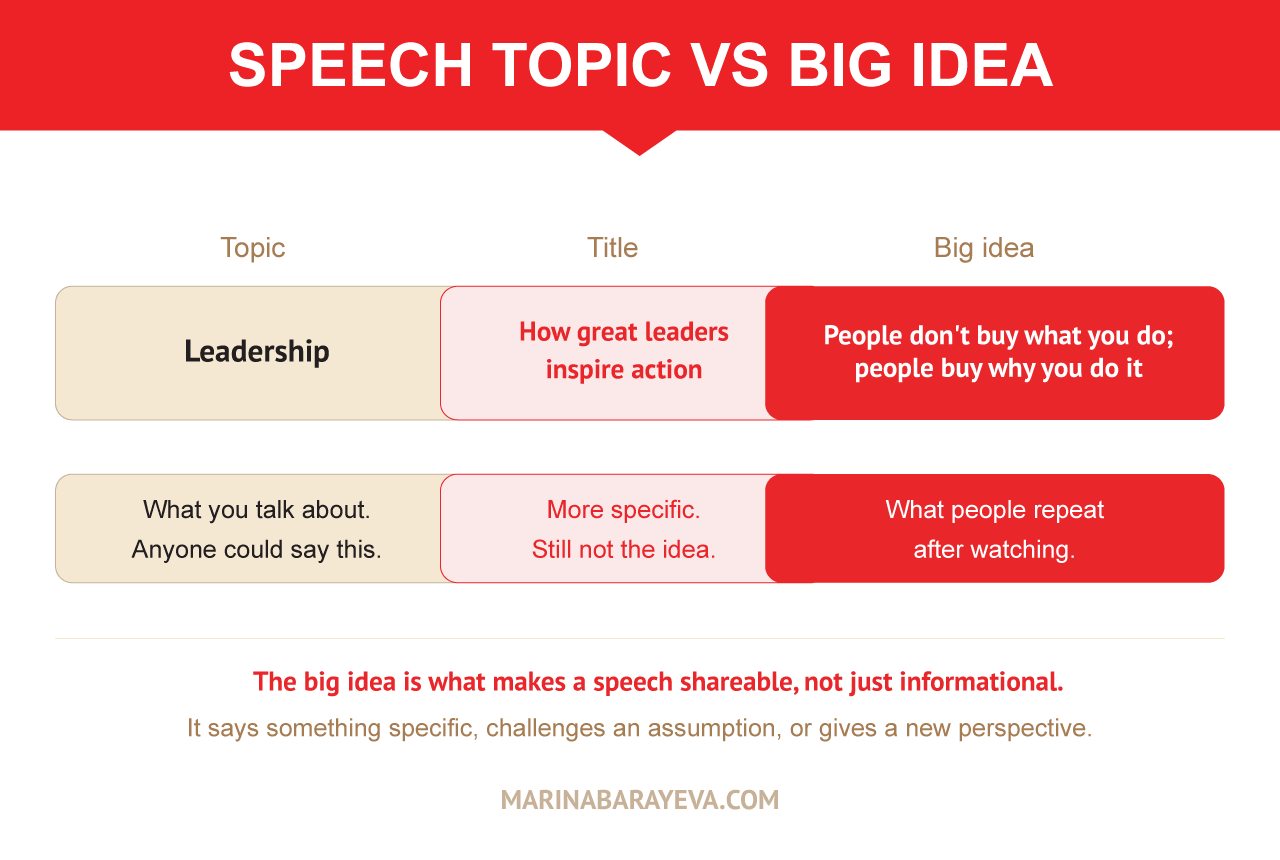
Take Simon Sinek’s TED Talk How Great Leaders Inspire Action. His topic was leadership, or specifically, how to be a better leader. Thousands of speakers have given talks on that exact same topic.
But if you carefully look at Simon Sinek’s TED talk, you’ll see a clear distinction between a TED talk topic and a big idea worth spreading.
- His topic: helping people become better leaders
- His TED talk title: How Great Leaders Inspire Action
- His big idea: People don’t buy what you do; people buy why you do it.
The difference between a topic and an idea in a speech
The difference between a topic and an idea in a speech is that a topic is what you talk about.
A big idea is what you want people to believe, feel, or do after hearing you. It’s what they can share.
Think about topics like “resilience,” “confidence,” or “leadership.” They’re broad and describe a subject area.
Now compare those to big ideas:
- Topic: Resilience
- Big idea: Resilience isn’t something you build by being strong. It’s something you build by being honest about when you’re not.
The second one challenges an assumption and gives the audience a new perspective.
The idea is shareable. A topic is not.
That’s why speakers like Simon Sinek and Brené Brown are still being quoted years later. They didn’t just present topics. They built their entire talk around one core idea.
So once you know your TED Talk topic, your next step in how to do a TED Talk is to define your big idea.
Step 2: Define your Big Idea
Your big idea is the central insight you want to share. The one thing you’d want someone to repeat to a friend after watching your talk.
If you’re serious about learning how to do a TED Talk, this is where you start.
Think about:
- What do you know to be true that most people haven’t heard yet?
Here’s a test. Say your idea out loud in one or two sentences. If you find yourself using phrases like “it’s really about…” or start explaining your whole talk, you’re not there yet.
And I mean a specific sentence. Not a vague one. Something that would make a stranger say, “Huh. Tell me more.”
What is a big idea in a speech?
In public speaking, a big idea is one key insight of the speech that you want people to remember, and you highlight it over and over again from different angles.
In the TED world, it’s also called throughline.
Think of it like the spine of your talk. Every story, every fact, every moment has to connect back to it.
It’s the invisible thread that makes the audience feel like everything you’re saying is going somewhere.
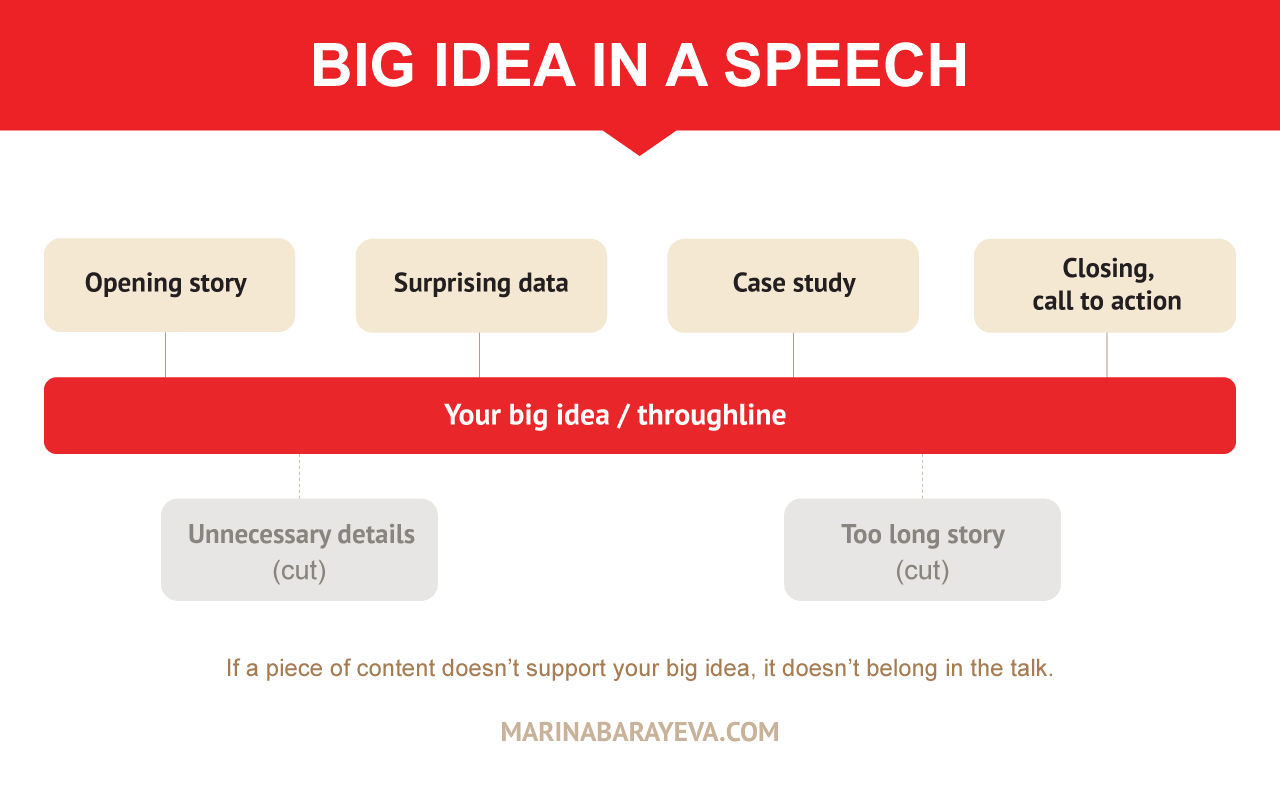
Every single thing in your talk should earn its place.
- Does this story make my idea more believable?
- Does this data make it more urgent?
- Does this example make it more memorable?
If not, cut it even if you love it.
Now, once you have your idea, you need to build a structure around it.
This is your next step in how to do a TED talk.
Step 3: Write your TED talk around one big idea
Your TED Talk structure needs to do one thing above all else: keep creating curiosity.
And it’s not just “what happened next”… But “what does this mean for me as a listener?”
This is where a great story can be especially useful because it can involve people in your TED talk.
And it brings us to the step that most people underestimate. There’s a specific storytelling technique that the best TED Talk Speakers use.
How to write a TED talk
A reliable structure for a TED Talk looks like this:
1. Open with tension
Start with a question, a contradiction, or a story that creates an itch your audience needs to scratch.
2. Introduce the big idea early
Give people a clear statement of what they’re about to explore, something they can anchor everything else to.
3. Add stories and insights
Give people something to feel, then something to think about.
4. Bring everything back to your big idea
Every story, stat, or example should bring the audience back to the central idea from a new angle.
5. Inspire action or shift perspectives
You don’t always need a call to action. But you always need the audience to leave seeing something differently.
Step 4: Use stories to keep the audience engaged
And you’ve probably heard: “Tell more stories.” But here’s what nobody tells you.
It’s not the story that keeps attention. It’s the moment inside the story where the audience realizes something about themselves.
The best TED speakers move in a constant cycle:
Story → Insight → Idea
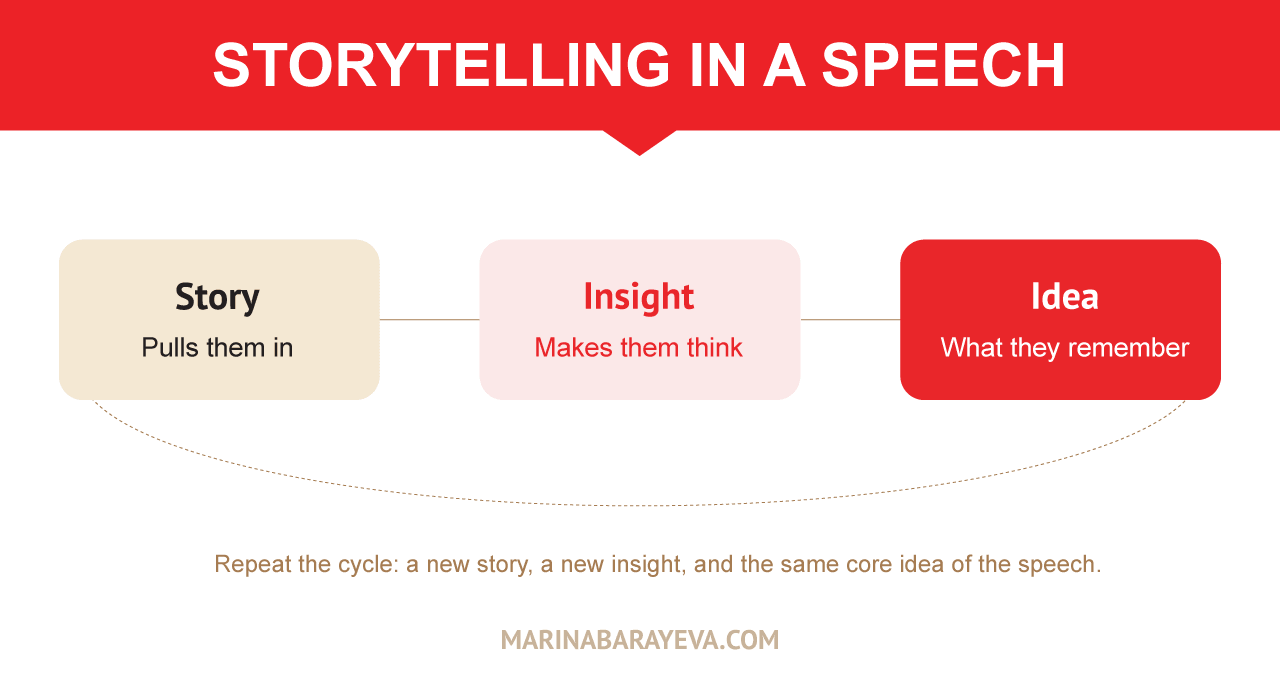
The story gets you involved, insight makes you think, and then a speaker keeps you focused on the core idea from a new angle.
You can mix these three elements, but they are always there.
Simon Sinek does this over and over in his TED Talk How Great Leaders Inspire Action.
He tells a story, shares an insight from it, and brings it back to the same throughline: people don’t buy what you do, they buy why you do it.
Adam Grant does it well too, in his TED Talk The Surprising Habits of Original Thinkers. He shares a personal story, and then he presents the concept of Originals.
And then, throughout his talk, he emphasizes how some people think differently and how ordinary people can do the same.
The stories keep you engaged, insights make you feel smart, but the idea is what you remember.
Test Your Stories
Here’s a quick test for every story you include: after hearing this, will the audience understand my big idea better or just know more about me?
If your stories serve the idea, keep them. If stories are interesting but disconnected, then remove them from your speech even if you like them.
The goal isn’t for people to remember the story. It’s for the story to make the idea relatable.
When you think about how to make a TED Talk memorable, this is the main principle.

WOULD YOU LIKE TO LAND A TEDx TALK WITHIN THE NEXT FEW MONTHS?
Get this TEDx guide that will help you prepare and increase your chances of getting accepted.
Now, here’s the step in how to do a TED talk that almost every first-time TED speaker doesn’t take seriously. And that’s why so many people feel nervous when they finally get on stage.
Step 5: Practice public speaking before you do a TED talk
If you get accepted to do a TED talk, you’re speaking in front of over a thousand people.
If you do a TEDx talk, which is smaller, most of the time, you are in front of a hundred people. Only some TEDx events can host a large audience.
That’s a lot. Especially if you haven’t done much public speaking before.
But here’s what I want you to understand. You don’t need to perform a TED talk. You need to believe it.
The speakers who move people are the ones who mean every word they say.
So start practicing public speaking. Not just your TED talk, but speaking in general.
Use every opportunity to speak, start collecting and telling the stories that you can share in your TEDx talk.
The next step in how to do a TED talk is getting your TED Talk application ready.
Step 6: Prepare your TED talk application
Once your idea is solid, prepare all the information about your TED talk and yourself as a speaker.
Then, fill out the TED talk application.
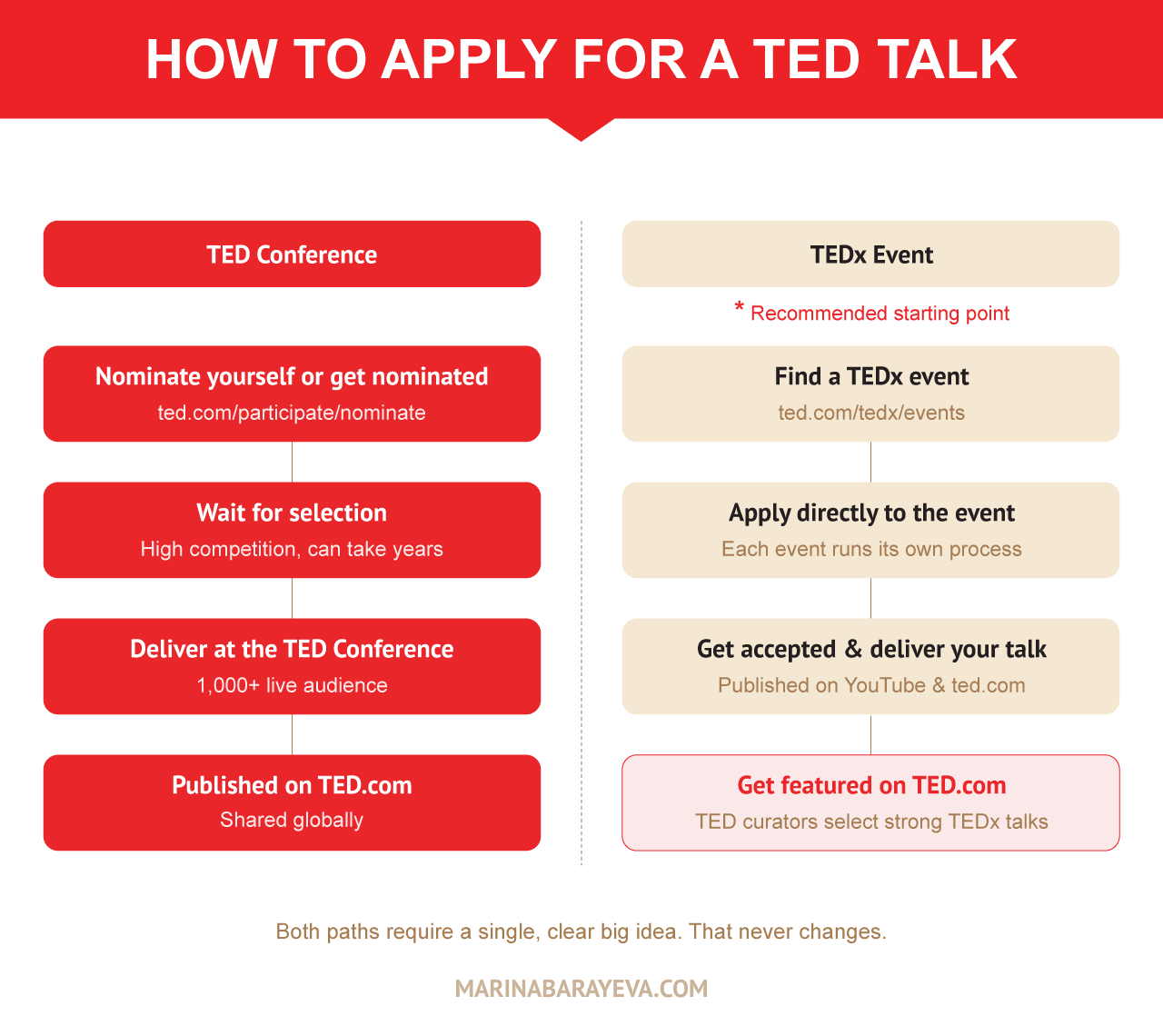
Now, TED and TEDx have different application processes.
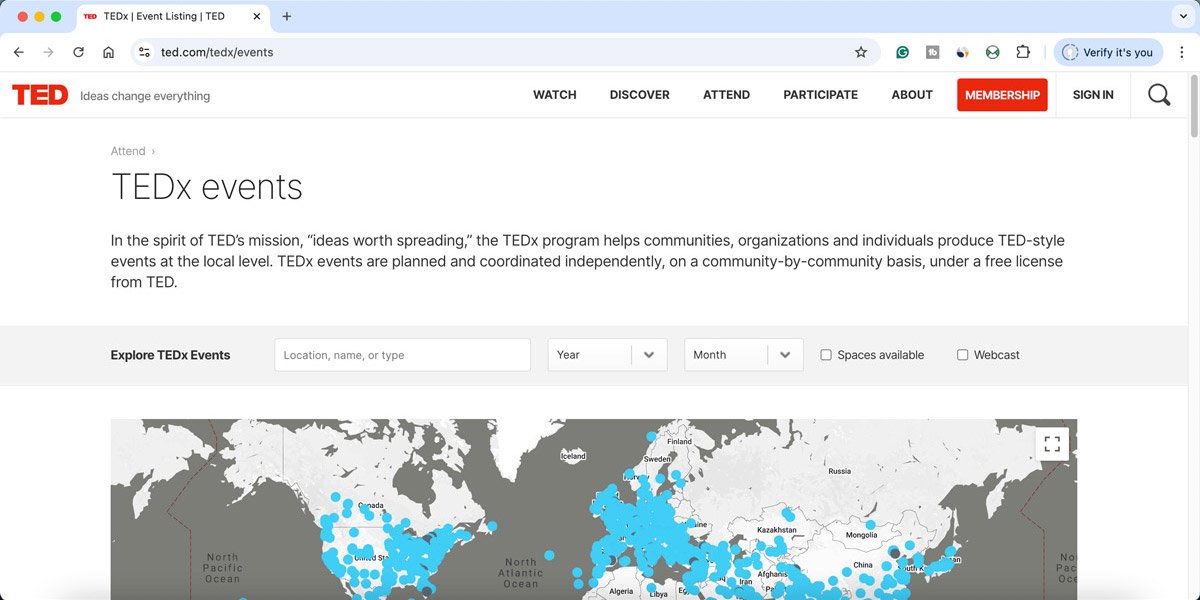
How to find TEDx events
All planned TEDx events are listed at ted.com/tedx/events. Each event runs its own application. Find one in your area (or one that accepts remote submissions), review their specific requirements, and apply directly to them. There’s no central TEDx application.
How to do a TED talk
To apply to speak at a TED conference, you need to fill out the nomination form at ted.com/participate/nominate.
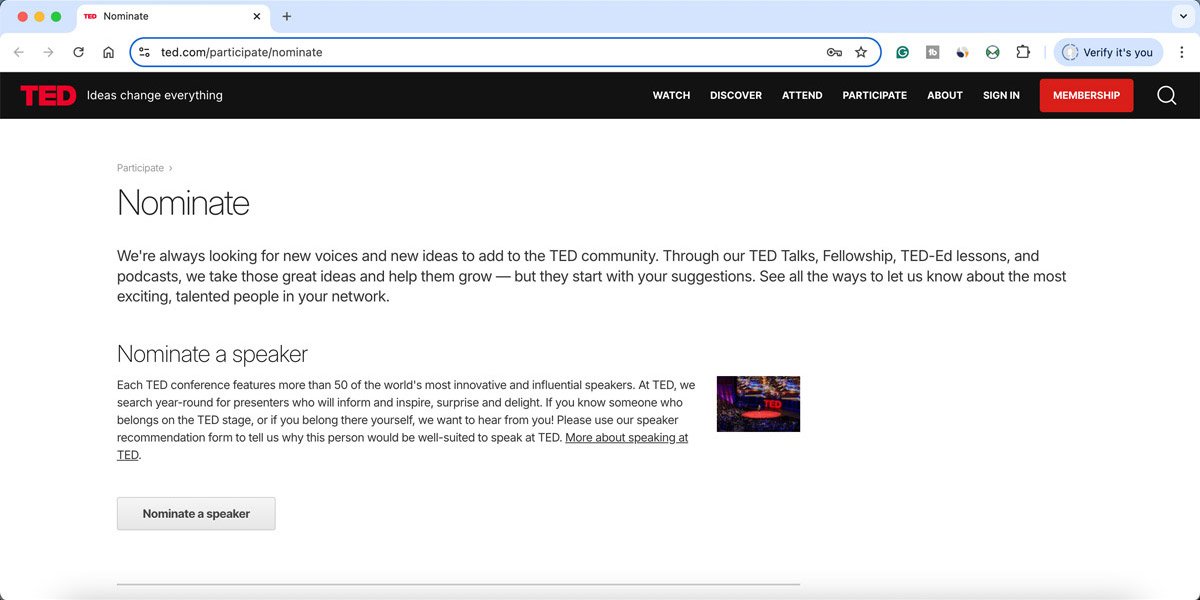
Anyone can nominate a speaker, including yourself.
TED also runs additional programs with their own criteria, so it’s worth reviewing all the options if you fit specific categories.
After you submit a TED talk application, it may take a long time before you get accepted to do a TED talk. Simply because the competition is very high.
If you’re selected, then TED conference organizers will contact you with further steps.
Step 7: Deliver a TED talk
Once you get accepted to do a TED talk, finalize your script and slides, if you have them.
Then, on the day of your talk, you step on stage, deliver it, and officially become a TED Talk speaker.
Your talk gets recorded, edited, and published on the TED YouTube channel and TED.com. From that point, it’s out in the world. People you’ve never met will watch it. Some of them will share it, some of them will quote it years later.
It’s a life-changing opportunity for many experts, and it can significantly boost your career.
Give a TEDx Talk first
For most people, to do a TED talk is too high bar right now. So, start with a TEDx talk.
Here’s something not many people know. TED curators are constantly looking for strong TEDx talks to feature as official TED Talks.
That means you can give a TEDx talk and still get featured as a TED speaker, reaching a global audience.
Such TEDx talks get a special note on the video.

It’s not easy to do a TED talk or give a TEDx talk and get featured on ted.com. But a TEDx talk can be your first step to a much bigger stage.
How to Do a TED Talk: What Actually Matters
After seven steps, here’s what it all comes back to. How to do a TED Talk means building a single idea that’s so clear and so specific that someone else can repeat it without you in the room.
One that makes someone stop and think, that gives them a new way to see something they thought they already understood.
That’s what turns a talk into something people share and builds the kind of credibility that follows you for years.
Start with the idea. Build everything else around it.
WOULD YOU LIKE TO LAND A TEDx TALK WITHIN THE NEXT FEW MONTHS?
Get this TEDx guide that will help you prepare and increase your chances of getting accepted.
FAQs
How long is a TED Talk?
TED Talks are typically 18 minutes or less. This limit is intentional. TED’s philosophy is that 18 minutes is long enough to present a serious idea with depth, and short enough that the TED Talk speaker can focus on the main idea. TEDx talks vary by event, but usually they are about 10–18 minutes.
Do you get paid to do a TED Talk?
TED is a non-profit organization so TED and TEDx speakers aren’t get paid. However, it gives speakers credibility and may open opportunities such as consulting offers, speaking invitations, and increased coaching or business rates.
How hard is it to get a TED Talk?
TED conference receives a lot of nominations and selects only a very small number of speakers each year. So, it’s extremely competitive. TEDx is more accessible. There are many TEDx events globally each year. The majority of people give a TEDx talk.
Can I apply for a TED Talk myself?
Yes. TED’s nomination form allows self-nominations. The key is showing a specific, compelling idea that is worth spreading. Focus on what you want the audience to believe after hearing you.
What’s the difference between TED and TEDx?
TED is the original main conference, organized and produced by the TED organization. TEDx events are independently organized under license from TED. They follow TED’s guidelines but are run by local organizers. TEDx talks can be nominated to appear on TED.com as featured talks if curators find them strong enough.
How do I find TEDx events to apply for?
All planned TEDx events are listed at ted.com/tedx/events. You can filter by location or search for events accepting applications. Each event has its own application process, timeline, and criteria, so check the individual event pages for details.
Do I need slides for a TED Talk?
No. Slides are optional, not required. Many of the most memorable TED Talks, including Simon Sinek’s TED Talk, use minimal or no slides. If you use them, make them support your idea, not repeat what you’re saying.
What makes a TED Talk go viral?
The combination of a specific, thought-provoking idea + high emotional engagement + broad relevance. Talks that go viral often challenge a common assumption, use personal stories to create connection, and leave the audience with an idea they want to share. Production quality matters less than speakers think.